
Choosing the right cordless pool cleaner can be the difference between a crystal-clear swimming experience and hours of manual work. In this head-to-head comparison, we evaluate the Wybot S1 vs Aiper Scuba S1—two powerful robotic cleaners engineered for residential pool owners seeking autonomous, efficient, and deep-cleaning performance. Let’s break them down across every critical metric.
Contents
Differences Between Wybot S1 vs Aiper Scuba S1
Below is a summary of the specifications:

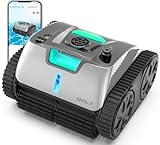
Design Comparison
Both models are designed for in-ground and above-ground pools, with nearly identical maximum pool sizes—1,615 sq ft for the Wybot S1 and 1,600 sq ft for the Aiper Scuba S1. This makes them suitable for medium to large residential pools.
These are cordless units, eliminating the limitations of cable length and tangling. As such, neither requires an anti-tangle swivel mechanism, and both offer the flexibility of wireless operation throughout the pool environment.
Weighing in at 7.7 kg (17 lbs) each, both units are relatively lightweight for full-featured pool robots. They are easy to lift, carry, and deploy—even for single users. Their compact forms also support straightforward storage.
Winner: Tie
Both robots share similar physical designs and portability. There is no decisive advantage in this category.
Cleaning Performance Comparison
The Wybot S1 offers slightly more comprehensive cleaning coverage. It not only scrubs the floor, wall, and waterline, but also navigates steps and slopes—a major plus for irregular-shaped pools. The Aiper Scuba S1, while excellent, lacks support for steps and slopes.
The brush systems diverge significantly. Wybot S1 uses dual active PVC scrubbing brushes, enabling stronger contact and wider surface agitation during cleaning. In contrast, the Aiper Scuba S1 utilizes a single active PVC roller, effective for general debris removal but with slightly less mechanical action.
In terms of suction, the Aiper Scuba S1 wins decisively with a powerful 4,200 GPH suction rate, compared to Wybot S1’s 3,038 GPH. This higher flow rate ensures more rapid debris removal and better performance with fine particles.
The Scuba S1’s dual-layer filtration system with 3.5 L capacity sets it apart. It traps both large debris and microscopic contaminants with its 180 μm coarse filter and 3 μm fine filter. Wybot’s filtration system uses a standard fine-mesh cartridge but lacks the multi-layer trapping depth of Aiper’s system.
Battery performance also leans in Aiper’s favor. The Scuba S1 lasts up to 180 minutes, while the Wybot S1 caps at 150 minutes. Both take approximately 3–4 hours to fully recharge.
Winner: Aiper Scuba S1
Thanks to its powerful suction, longer runtime, and advanced dual-layer filtration, the Aiper Scuba S1 provides superior cleaning performance overall.

Feature Comparison
In terms of navigation, both units excel but with different approaches. Wybot S1 uses a gyro-based system that follows wall-first and floor-cleaning logic. It reliably maps and follows a smart path while optimizing coverage. Aiper’s WavePath™ 2.0 offers structured grid-based coverage, ensuring methodical, complete cleaning with minimal overlap.
Where Wybot pulls ahead is smart control. It includes app connectivity via the Wybot App, allowing remote start, schedule setting, and performance monitoring directly from a smartphone. The Aiper Scuba S1 lacks any app integration, relying solely on manual mode switching.
Both robots are IPX8 waterproof rated, ensuring safe and long-term underwater operation. Wybot also features auto-parking near the pool wall when the battery runs low, making retrieval easier.
Neither includes advanced features like wireless charging, LED displays, or OTA firmware updates.
Winner: Wybot S1
Wybot’s smart app control and self-parking feature give it the edge for users who want connected convenience and automation.
Quick Rundown Of Wybot S1


Quick Rundown Of Aiper Scuba S1

Conclusion
Choose Wybot S1 if you want enhanced scrubbing with dual brushes, smart app control, and step/slope compatibility—ideal for irregular pool shapes and users who prefer tech-driven automation.
Choose Aiper Scuba S1 if you prioritize powerful suction, superior filtration, and extended runtime—perfect for deep-cleaning debris-heavy pools without manual effort.
Overall Winner: Aiper Scuba S1
With its stronger suction, longer runtime, and advanced debris filtration, the Aiper Scuba S1 delivers better all-around performance for most residential pool owners, making it the more effective and efficient choice in 2025.