
The Makita LS1219L vs Bosch GCM12SD are two of the most advanced 12-inch sliding compound miter saws available to professional contractors and serious woodworkers. Both models emphasize precision, cutting capacity, and durability, but their design philosophies differ significantly.
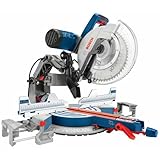
The Makita LS1219L prioritizes space efficiency, consistent cutting power, and excellent dust collection, while the Bosch GCM12SD stands out with its unique Axial-Glide system, superior ergonomics, and a compact footprint. In this in-depth comparison, we will analyze every critical detail to determine which miter saw provides greater value for long-term professional use.

Contents
Differences Between Makita LS1219L vs Bosch GCM12SD
Below is a summary of the specifications:

Motor Power and Cutting Performance
The Makita LS1219L features a 15-amp direct-drive motor operating at 3,200 RPM. While it has slightly lower RPM than Bosch, its soft-start function prevents abrupt startup jolts, and its constant speed control maintains consistent blade speed under load. This results in smooth, precise cuts when working with hardwoods, trim, or fine cabinetry.
The Bosch GCM12SD runs at a faster 3,800 RPM, giving it an advantage in raw cutting speed. This higher RPM makes it excellent for cutting through framing lumber, plywood, and thicker stock quickly. However, without variable speed or constant speed features, it lacks the adaptability that Makita provides for delicate applications.
Winner: Makita LS1219L – Despite lower RPM, its soft-start and constant speed technology ensure more consistent performance across a wider variety of materials.
Cutting Capacity and Versatility
The Makita LS1219L is engineered for large capacity. It offers a 15-inch crosscut width and a 6.75-inch vertical cut height, making it one of the most capable saws in its category. Its ability to cut 8-inch crown molding nested vertically surpasses most competitors, making it a preferred choice for trim carpentry, baseboards, and tall moldings.
The Bosch GCM12SD provides a slightly smaller 14-inch crosscut capacity and 6.5-inch vertical cutting height, while supporting 6.5-inch crown molding nested. Though still highly capable, it does not quite match the reach of Makita’s vertical and crown molding capacity.
Winner: Makita LS1219L – Larger crosscut and crown molding capacity give it an advantage in versatility.

Miter and Bevel Adjustments
The Makita LS1219L offers a 60° miter range left and right, exceeding Bosch’s 52° left and 60° right. Its 48° dual bevel range ensures compound cuts can be executed efficiently without repositioning the workpiece. Adjustment controls are smooth and user-friendly, designed for fine-tuned accuracy.
The Bosch GCM12SD provides a miter range of 52° left and 60° right, with a 47° dual bevel range. While slightly smaller than Makita’s, Bosch’s Axial-Glide system provides exceptional smoothness and accuracy in its adjustments, ensuring precise alignments with minimal effort.
Winner: Tie – Makita offers a wider range, while Bosch delivers smoother and more ergonomic adjustments.
Precision and Accuracy
The Makita LS1219L uses a built-in laser guide system that projects a visible line for cut alignment. While effective, lasers can fade under bright light and require recalibration over time.
The Bosch GCM12SD relies on its Axial-Glide system, which not only eliminates traditional sliding rails but also ensures consistent, accurate alignment over years of use. The reduced friction and stable motion improve long-term accuracy, even without a laser or LED cutline system.
Winner: Bosch GCM12SD – The Axial-Glide system delivers exceptional accuracy and long-term stability without calibration issues.
Build Quality and Portability
The Makita LS1219L weighs 65 lbs, making it relatively lighter compared to Bosch. Its forward rail system allows it to sit flush against a wall, saving workspace and making it an excellent choice for smaller shops. Its build emphasizes precision engineering, with smooth rail slides and durable construction.
The Bosch GCM12SD is significantly heavier at 88 lbs, which makes it less portable but adds stability during cuts. Its folding Axial-Glide arms reduce the saw’s footprint by up to 12 inches compared to traditional rail systems, making it more compact despite its size and weight.
Winner: Makita LS1219L – Lighter weight and forward rail design make it more portable and space-efficient.

Dust Collection Efficiency
The Makita LS1219L provides up to 80% dust collection efficiency with its dual dust ports, capturing debris directly from the blade housing. This makes it a strong performer in shop environments where air quality is critical.
The Bosch GCM12SD achieves around 75% dust collection efficiency when paired with a shop vacuum. While effective, it does not capture as much fine dust as Makita, requiring more cleanup after prolonged use.
Winner: Makita LS1219L – Superior dust collection efficiency ensures a cleaner and healthier workspace.
Ease of Use and Adjustability
The Makita LS1219L is designed with micro-adjust bevel controls, forward rail slides, and smooth cutting action. Its space-saving design allows for installation in smaller work areas without sacrificing performance. These features make it extremely user-friendly for professionals working in limited space environments.
The Bosch GCM12SD excels in ergonomics with its Axial-Glide arms and upfront bevel controls. Adjustments are smooth, and the absence of rails makes for hassle-free operation. The saw is intuitive, and its glide motion system is often considered one of the smoothest cutting actions in the industry.
Winner: Tie – Makita excels in compact design and precise controls, while Bosch leads in ergonomic usability and glide action.
Quick Rundown Of Makita LS1219L


Quick Rundown Of Bosch GCM12SD
Conclusion
The Makita LS1219L and the Bosch GCM12SD are both top-tier professional miter saws, but they emphasize different strengths. The Makita LS1219L shines in cutting capacity, dust collection, and space-saving design, making it ideal for trim carpenters, cabinet makers, and professionals who prioritize precision in compact workshops.
The Bosch GCM12SD, however, excels in long-term accuracy, ergonomics, and smooth cutting motion thanks to its Axial-Glide system. It is the saw of choice for professionals who value unmatched glide action and stable performance in larger shop environments.
Overall Winner: Makita LS1219L – With superior cutting capacity, better dust collection, and space-efficient engineering, the Makita LS1219L offers the most versatility and practicality, making it the stronger investment for professionals seeking a balance of power, precision, and portability.