
The Makita LS1040 vs DeWalt DW713 are two highly respected 10-inch compound miter saws designed for professionals and demanding DIYers who require accuracy, portability, and durability. Both models offer strong motors, bevel capabilities, and practical features that make them stand out in the compact miter saw category.
However, they approach cutting performance and user experience differently. This detailed comparison explores every aspect of these two saws to help determine which provides greater long-term value.

Contents
Differences Between Makita LS1040 vs DeWalt DW713
Below is a summary of the specifications:

Motor Power and Performance
Both the Makita LS1040 and DeWalt DW713 are equipped with 15-amp motors, delivering plenty of cutting strength for most trim, molding, and framing applications. However, the difference lies in blade speed.
The Makita LS1040 runs at 4,600 RPM, ensuring smooth, clean cuts with reduced tear-out, especially in hardwoods and fine molding. Its motor is engineered for long-term durability, with ball-bearing construction and smooth startup.
The DeWalt DW713 spins faster at 5,000 RPM, giving it an advantage in raw speed. This allows faster crosscuts and more efficient work on softer materials and dimensional lumber. However, the faster speed may create more tear-out when cutting delicate trim unless paired with a fine-tooth blade.
Winner: DeWalt DW713 – Higher RPM offers faster cutting capability and greater efficiency for jobsite productivity.
Cutting Capacity and Versatility
The Makita LS1040 provides a 2.75-inch by 5.1-inch crosscut capacity at 90 degrees, making it effective for smaller dimensional lumber and trim. At a 45-degree miter cut, it handles 1.3-inch by 3.5-inch material, which suits light-duty applications.
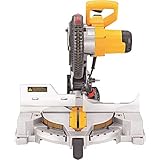
The DeWalt DW713 delivers more cutting versatility, with a 3.5-inch by 6-inch crosscut capacity at 90 degrees and 2-inch by 4-inch capacity at a 45-degree miter. This gives it the ability to handle larger crown molding, baseboards, and wider stock.
Winner: DeWalt DW713 – Superior cutting capacity makes it more adaptable for diverse projects.

Miter and Bevel Adjustments
The Makita LS1040 offers a miter range of 0°–45° left and 0°–52° right, giving users a good amount of flexibility for angled cuts. It includes positive miter stops at common angles such as 15°, 22.5°, 30°, and 45°, which speed up adjustments.
The DeWalt DW713 provides a miter range of 0°–50° left and right, which is slightly wider on the left side than the Makita. Its cam-lock miter handle makes adjustments fast and secure, while the detent plate has 11 positive stops for greater accuracy.
In terms of bevel, the Makita tilts 0°–45° left only, while the DeWalt tilts 0°–48° left, giving it a slight edge. The DeWalt’s tall sliding fence design supports larger crown molding vertically, increasing its versatility.
Winner: DeWalt DW713 – Wider miter range, more bevel flexibility, and better fence support give it the advantage.
Precision and Accuracy
Makita focuses on smooth operation and consistent alignment with its LS1040. Its dual aluminum fence system ensures accurate support, and its robust motor maintains cutting precision with minimal vibration. This makes it especially suitable for finish carpentry and applications where clean cuts are critical.
The DeWalt DW713 incorporates a stainless steel miter detent plate with 11 stops, ensuring repeatable accuracy and durability over years of use. Its detent override feature allows quick adjustments without slipping into preset angles, giving professionals confidence in maintaining precision.
Winner: DeWalt DW713 – More miter detents and the ability to override them without losing alignment make it the more precise option for repeatable accuracy.
Build Quality and Portability
The Makita LS1040 stands out for its lightweight build, weighing only 27.3 lbs. This makes it highly portable and one of the easiest 10-inch compound miter saws to transport to job sites or move around a workshop. Despite its light weight, it maintains strong construction and durability.
The DeWalt DW713 weighs 35 lbs, making it heavier but still portable. Its rugged housing, reinforced base, and tall fence system reflect DeWalt’s emphasis on jobsite toughness. It is built to handle demanding environments with repeated transport and use.
Winner: Makita LS1040 – Its lightweight design makes it the more portable option, ideal for those who prioritize mobility.

Dust Collection Efficiency
The Makita LS1040 comes with a standard dust bag and port, which captures a portion of sawdust but leaves much cleanup behind. It performs adequately for light use but may not satisfy workshop users who prioritize dust control.
The DeWalt DW713 also includes a dust port, designed for use with vacuum attachments. While it captures more debris than the Makita, it still falls short of premium dust collection systems found in higher-end saws.
Winner: DeWalt DW713 – Slightly more effective dust collection, though both are modest compared to larger models.
Ease of Use and Adjustability
The Makita LS1040 is praised for its simplicity and intuitive design. Its controls are straightforward, making it a user-friendly saw for both beginners and professionals. The lightweight design further enhances ease of setup.
The DeWalt DW713, while heavier, incorporates cam-lock miter handles, bevel detents, and a tall sliding fence, giving it more adjustability and versatility. Professionals benefit from its efficiency and ability to handle diverse cuts with minimal setup time.
Winner: DeWalt DW713 – Greater adjustability and efficiency for professional use.
Quick Rundown Of Makita LS1040


Quick Rundown Of DeWalt DW713
Conclusion
The Makita LS1040 and DeWalt DW713 are both excellent compact miter saws, but they excel in different areas. The Makita LS1040 shines in portability, simplicity, and smooth cutting performance, making it an ideal choice for users who prioritize mobility and straightforward operation. On the other hand, the DeWalt DW713 dominates in cutting capacity, precision, and professional-grade adjustability, making it the better option for contractors and woodworkers handling larger and more demanding projects.
Overall Winner: DeWalt DW713 – With superior cutting capacity, greater precision features, and professional durability, the DeWalt DW713 stands out as the more versatile and capable saw, offering long-term value for serious users.