
The demand for compact portable power stations has been rising as outdoor enthusiasts, campers, and homeowners look for reliable, eco-friendly solutions to power essential devices. Two models that consistently stand out in this entry-level category are the Jackery Explorer 240 and the Anker 521 PowerHouse. While both are designed to provide dependable off-grid power, they differ significantly in terms of battery technology, output performance, recharging speed, and long-term usability.
This detailed comparison of the Jackery Explorer 240 vs Anker 521 highlights their specifications and real-world performance to determine which model offers the best value.

Contents
Differences Between Jackery Explorer 240 vs Anker 521
Below is a summary of the specifications:
Battery Capacity and Lifespan
The Jackery Explorer 240 comes with a 240Wh lithium-ion (NMC) battery, providing a compact yet effective power supply for small electronics like smartphones, cameras, tablets, and fans. However, its lifespan is limited to around 500 charge cycles, meaning its overall long-term durability is modest compared to modern standards.
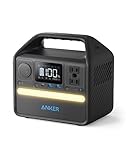
The Anker 521 PowerHouse slightly outpaces Jackery with a 256Wh capacity, giving a little more runtime per charge. More importantly, it uses LiFePO₄ battery technology, offering over 3000 cycles before dropping to 80% capacity. This is a major advantage for users who rely on their power station frequently, ensuring years of dependable use.
Winner: Anker 521 PowerHouse – With a longer lifespan and durable battery chemistry, it outperforms the Jackery in long-term reliability.

Power Output and Device Compatibility
Both models provide a 200W AC output, making them suitable for laptops, cameras, lights, and small electronics. However, there are key differences in surge power and outlet availability.
The Jackery Explorer 240 delivers up to 400W surge output and includes a limited port selection: 1 AC outlet, 2 USB-A ports, and 1 car outlet. While sufficient for basic use, it lacks versatility for users who need to power multiple devices simultaneously.
The Anker 521 PowerHouse offers 450W surge capability, providing extra stability when powering devices that draw sudden bursts of energy. It includes 6 total ports: 2 AC outlets, 2 USB-A ports, 1 USB-C port, and 1 car outlet. The inclusion of a USB-C port is especially valuable for charging modern laptops, tablets, and fast-charging smartphones without needing adapters.
Winner: Anker 521 PowerHouse – With more ports and stronger surge capacity, it provides greater flexibility and modern compatibility.
Charging Speeds and Solar Integration
Recharging efficiency is another major area where these two units differ.
The Jackery Explorer 240 requires approximately 5.5 hours to recharge from AC power, which can feel slow for users needing quick turnaround between uses. Its solar input capacity maxes out at 60W, allowing off-grid charging with Jackery’s SolarSaga panels, but the speed remains relatively modest.
The Anker 521 PowerHouse recharges in about 2.5 hours using its dual-input capability (AC wall charging combined with USB-C PD). This makes it one of the fastest-charging portable power stations in its class. It also supports up to 65W of solar input, slightly higher than Jackery, enabling more efficient off-grid charging in optimal sunlight conditions.
Winner: Anker 521 PowerHouse – With rapid recharging and slightly better solar input, it is more convenient for regular use.

Portability and Build Design
The Jackery Explorer 240 is known for its lightweight build at just 6.6 lbs (3 kg), making it one of the most portable units available. Its iconic orange-and-black casing, combined with a sturdy built-in handle, makes it ideal for quick trips, camping, and light-duty use. Its size and weight give it an advantage for those prioritizing minimal carry weight.
The Anker 521 PowerHouse weighs 8.2 lbs (3.7 kg), making it slightly heavier. However, it is still compact and easy to carry, while offering a more rugged design. Anker emphasizes durability, ensuring the unit can withstand outdoor use while still being highly portable.
Winner: Jackery Explorer 240 – With its lighter weight, it is easier to transport, though Anker remains close behind in portability.
Smart Features and Usability
Neither the Jackery Explorer 240 nor the Anker 521 PowerHouse includes app connectivity, which is common for higher-end models. Both rely on their onboard displays to show critical information such as battery level, input, and output wattage.
While both units are straightforward to use, the Anker 521 offers a slight advantage by including more outputs, making it easier to manage multiple devices at once without extra adapters.
Winner: Anker 521 PowerHouse – Its broader port selection enhances usability, even without app control.
Quick Rundown Of Jackery Explorer 240
No products found.

Quick Rundown Of Anker 521
Conclusion
The Jackery Explorer 240 and Anker 521 PowerHouse are both excellent portable power stations, but they are designed for slightly different audiences.
The Jackery Explorer 240 excels in lightweight portability and simplicity, making it a strong choice for short trips, casual camping, and occasional use. Its compact design and ease of use remain appealing to entry-level buyers.
The Anker 521 PowerHouse, however, delivers far better long-term value and modern functionality. With its LiFePO₄ battery offering thousands of cycles, faster recharging speed, additional ports, and higher surge capacity, it is better suited for users who need a more durable and versatile portable power station.
Overall Winner: Anker 521 PowerHouse – While the Jackery Explorer 240 is a dependable lightweight option, the Anker 521 provides greater durability, faster charging, and broader device compatibility, making it the superior choice for long-term, everyday use.