
The DeWalt DWS716XPS vs DeWalt DWS779 are two of the most sought-after 12-inch compound miter saws from DeWalt’s professional lineup. Both are built to deliver power, precision, and durability, yet they serve different needs. The DWS716XPS is a dual-bevel compound saw with the innovative XPS shadow line cut positioning system, while the DWS779 is a sliding compound saw designed for extended cutting capacity on larger materials.
In this comprehensive comparison, we evaluate their motor performance, cutting capacities, precision systems, usability, and overall value to determine which saw is best suited for contractors, woodworkers, and serious DIY enthusiasts.

Contents
Differences Between DeWalt DWS716XPS vs DeWalt DWS779
Below is a summary of the specifications:
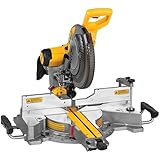

Motor Power and Blade Speed
The DWS716XPS is equipped with a 15-amp motor delivering 3,800 RPM, making it capable of handling everything from dense hardwoods to framing lumber with ease. Its direct-drive motor ensures consistent power without bogging down during heavy use.
The DWS779 features the same 15-amp motor with a 3,800 RPM blade speed, giving it identical power on paper. However, the addition of sliding rails means it can maintain that cutting power across wider boards without sacrificing performance. Both saws perform equally well in terms of raw cutting power.
Winner: Tie – Both saws deliver strong, consistent power with 3,800 RPM speeds.
Cutting Capacity and Versatility
The DWS716XPS offers a 2 x 8 crosscut capacity at 90° and 2 x 6 at 45°, with the ability to cut 6.5-inch vertical baseboards and 6.625-inch crown molding nested. Its dual-bevel capability tilts left and right up to 48°, allowing efficient compound cuts without flipping the workpiece.
The DWS779, with its sliding rails, far exceeds this. It delivers a massive 2 x 14 crosscut capacity at 90° and 2 x 10 at 45°, while supporting 6.75-inch vertical baseboards and 7.5-inch crown molding nested. This makes it ideal for large trim, wide boards, and framing projects requiring extended reach.
Winner: DeWalt DWS779 – Sliding rails give it unmatched cutting capacity.

Miter and Bevel Adjustments
The DWS716XPS has a 50° miter range both left and right with 14 positive stops, offering precise angle settings for repetitive cuts. Its dual-bevel design tilts 48° in both directions, streamlining compound cutting.
The DWS779 provides a broader 60° miter range to the right and 50° to the left, with 10 positive stops. While it lacks the extra detent stops of the DWS716XPS, its extended right miter capability gives more flexibility for complex angles, particularly in custom framing.
Winner: Tie – DWS716XPS offers more detents for accuracy, while DWS779 has a wider miter range.
Precision and Accuracy
The DWS716XPS integrates DeWalt’s XPS LED shadow line system, which projects the blade’s shadow onto the workpiece. This system is more accurate than traditional lasers since it never requires calibration and always aligns with the blade itself. The XPS system dramatically improves visibility and precision, particularly in detailed trim and cabinetry work.
The DWS779 does not include the XPS system, relying solely on its stainless-steel detent plate for angle accuracy. While still precise in miter and bevel adjustments, it lacks the instant visual alignment that makes the XPS-equipped model more efficient for fine woodworking.
Winner: DeWalt DWS716XPS – The XPS shadow line system makes it significantly more precise.
Build Quality and Portability
The DWS716XPS weighs just 44 lbs, making it lightweight and portable. Its ergonomic design allows contractors to easily transport it between job sites without sacrificing durability. Despite its light weight, it remains stable during use.
The DWS779 is substantially heavier at 67 lbs, largely due to its sliding rail system. While less portable, the additional weight gives it stability when handling wide stock. It is better suited for stationary setups in workshops rather than frequent transport.
Winner: DeWalt DWS716XPS – More portable and practical for mobile contractors.

Dust Collection Efficiency
The DWS716XPS comes with a rear-mounted dust port, designed to be connected to a dust bag or vacuum system. While functional, its dust collection is average, capturing only part of the debris.
The DWS779 uses the same dust port system but faces greater challenges due to the sliding mechanism, which tends to scatter dust more widely. While effective for larger chips, both saws perform similarly in this area.
Winner: DeWalt DWS716XPS – Slightly better efficiency since it lacks the extra dust spread caused by sliding rails.
Ease of Use and Adjustability
The DWS716XPS is simple to operate with intuitive controls, smooth adjustments, and the XPS cut alignment system, which reduces setup time and ensures accuracy. Its dual-bevel design enhances workflow efficiency, particularly in trim carpentry.
The DWS779, while bulkier, is equally reliable once set up. Its sliding rails make it more versatile for larger projects, but its lack of XPS alignment requires extra care for precision. Contractors working with larger boards will find it indispensable, but those who value speed and alignment accuracy may prefer the XPS-equipped model.
Winner: DeWalt DWS716XPS – The XPS system streamlines workflow and ensures faster, more accurate setup.
Quick Rundown Of DeWalt DWS716XPS


Quick Rundown Of DeWalt DWS779
Conclusion
The DeWalt DWS716XPS and DeWalt DWS779 are both exceptional 12-inch miter saws, each built to excel in different environments. The DWS716XPS shines with its lightweight portability, precision-focused XPS shadow line system, and efficient dual-bevel adjustments, making it ideal for trim carpenters and contractors who need accuracy and mobility.
The DWS779, on the other hand, is built for large-scale projects, framing, and wide board cuts. Its sliding rails, greater crown molding capacity, and extended crosscut reach make it the superior choice for workshop setups where portability is less important.
Overall Winner: DeWalt DWS779 – With its unmatched sliding capacity and versatility for large materials, it outperforms the DWS716XPS in overall cutting power, making it the better investment for professionals handling big projects. However, for precision-driven trim carpentry and maximum portability, the DWS716XPS remains an outstanding choice.