
The DeWalt DWS716 vs DeWalt DWS779 are two of DeWalt’s most trusted 12-inch compound miter saws, each engineered for precision, power, and durability. While they share common traits like robust build quality and professional-grade cutting performance, they cater to different user needs.
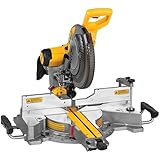
The DWS716 is a dual-bevel compound saw that prioritizes versatility and portability, while the DWS779 is a sliding compound saw designed for large-scale projects requiring maximum crosscut capacity. In this comprehensive comparison, we examine their motor performance, cutting capacities, precision features, usability, and overall value.

Contents
Differences Between DeWalt DWS716 vs DeWalt DWS779
Below is a summary of the specifications:

Motor Power and Blade Speed
Both the DWS716 and the DWS779 are equipped with a 15-amp motor running at 3,800 RPM. This motor delivers consistent torque and cutting power to handle everything from softwood trim to dense hardwoods and construction lumber.
The DWS716, being a non-sliding saw, channels its power into more compact and straightforward cutting tasks. Its motor is optimized for precision and reliability across common angles and trims.
The DWS779, with its sliding rail system, takes full advantage of the same motor to extend cutting capabilities. The motor maintains performance even when working with wider stock, making it a stronger candidate for large framing and flooring projects.
Winner: Tie – Both saws have identical motors, with performance optimized differently for their respective designs.
Cutting Capacity and Versatility
The DWS716 provides a 2 x 8 crosscut capacity at 90° and 2 x 6 at 45°. It handles 6.5-inch vertical baseboards and 6.625-inch crown molding nested, which is more than sufficient for most trim carpentry, cabinetry, and general woodworking projects.
The DWS779, however, delivers far greater reach with its sliding rails. It cuts up to 2 x 14 at 90° and 2 x 10 at 45°, making it significantly more capable when dealing with large boards. It also supports 6.75-inch vertical baseboards and 7.5-inch crown molding nested, giving it an advantage for finish carpentry on a grander scale.
Winner: DeWalt DWS779 – Sliding rails and extended crosscut capacity make it the superior choice for large projects.

Miter and Bevel Adjustments
The DWS716 offers a 50° miter range left and right, with 14 positive stops for repeatable accuracy. Its dual-bevel system tilts 48° both left and right, making compound cuts more efficient since the user doesn’t need to flip the workpiece.
The DWS779 expands the miter range to 60° right and 50° left, though it has only 10 positive stops. Its dual-bevel design also tilts 48° both directions, offering excellent flexibility for crown molding and angled cuts.
Winner: DeWalt DWS716 – More detents provide finer accuracy for repeated cuts, even though the DWS779 offers a wider miter range.
Precision and Accuracy
The DWS716 relies on a stainless-steel detent plate with 14 stops, ensuring accuracy and durability over time. This makes it highly dependable for repeatable cuts in framing, trim, and cabinetry work.
The DWS779 also uses a stainless-steel detent plate, though with fewer stops. However, its sliding capability enhances accuracy in large crosscuts, reducing the need for multiple passes and ensuring clean results on wider boards.
Winner: Tie – DWS716 excels in fine detent accuracy, while DWS779 provides precision through sliding reach.
Build Quality and Portability
The DWS716 weighs 44 lbs, making it relatively lightweight for a 12-inch dual-bevel saw. Its portability is a major advantage for contractors moving between job sites. Despite its compact size, it maintains excellent stability during operation.
The DWS779 weighs 67 lbs, largely due to its sliding rail system. While more challenging to move, the added weight improves stability for large projects. It is best suited for workshops or semi-permanent jobsite setups where mobility is less important.
Winner: DeWalt DWS716 – Lightweight and portable, ideal for mobile contractors.

Dust Collection Efficiency
Both the DWS716 and DWS779 are equipped with a rear dust collection port compatible with shop vacuums or dust bags.
The DWS716 delivers adequate performance, capturing a decent portion of debris but struggling with fine dust.
The DWS779, with its sliding rail system, disperses more sawdust during operation, though its design channels debris more efficiently into the dust port. When paired with a vacuum, it performs slightly better than the DWS716.
Winner: DeWalt DWS779 – Slightly better dust collection thanks to improved debris channeling.
Ease of Use and Adjustability
The DWS716 is designed for simplicity and efficiency. Its dual-bevel adjustments, lightweight build, and multiple detents make it user-friendly for professionals and advanced DIYers. It excels in speed and accuracy for repetitive cuts without requiring much setup time.
The DWS779, though heavier and bulkier, is equally user-friendly once set up. Its sliding rails extend its capabilities, making it versatile for a wider range of tasks. While it requires more space and effort to transport, it significantly increases efficiency in large-scale carpentry.
Winner: DeWalt DWS779 – More versatile and efficient for demanding professional projects.
Quick Rundown Of DeWalt DWS716


Quick Rundown Of DeWalt DWS779
Conclusion
Both the DeWalt DWS716 and DeWalt DWS779 are excellent miter saws, but they serve distinct purposes. The DWS716 is lightweight, portable, and versatile with its dual-bevel system, making it ideal for contractors who prioritize mobility and consistent precision on job sites.
The DWS779, on the other hand, is a workhorse with sliding rails and expanded cutting capacity, designed for professionals tackling large-scale projects, framing, or wide trim installations. While it sacrifices portability, it delivers unmatched versatility and power.
Overall Winner: DeWalt DWS779 – With its superior sliding capacity, dual-bevel versatility, and ability to handle larger materials, it stands as the ultimate professional choice. The DWS716 remains an excellent option for contractors who value portability and straightforward accuracy.