
The Bosch GCM12SD vs DeWalt DWS780 are among the most trusted 12-inch sliding compound miter saws on the market. Both cater to contractors, woodworkers, and serious DIYers who demand precision, power, and reliability.
While they share similarities in motor strength and cutting capacity, their design philosophies, ease of use, and feature sets diverge significantly. This comprehensive comparison will explore every detail to determine which saw provides greater value for long-term use.

Contents
Differences Between Bosch GCM12SD vs DeWalt DWS780
Below is a summary of the specifications:

Motor Power and Performance
Both the Bosch GCM12SD and the DeWalt DWS780 use a 15-amp motor producing up to 3,800 RPM, more than enough power to cut through hardwoods, pressure-treated lumber, and composite materials.
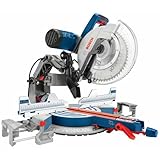
The Bosch GCM12SD pairs its motor with the axial-glide system, which replaces the traditional rail slide with articulated arms. This unique engineering delivers a smooth, resistance-free cutting motion and ensures precise alignment even under heavy use. It also requires less maintenance compared to traditional sliding rails.
The DeWalt DWS780, while using a conventional dual-rail system, adds the XPS cross-cut LED light system, which projects a shadow line across the cut path. This provides a real-time, highly accurate cutting guide that enhances precision without requiring calibration like laser systems.
Winner: Tie – Bosch provides smoother mechanical action, while DeWalt enhances precision with its innovative LED shadow line.
Cutting Capacity and Versatility
The Bosch GCM12SD offers a 14-inch horizontal crosscut capacity, slightly surpassing the DeWalt DWS780’s 13.75-inch capacity. Both can handle large framing lumber, trim boards, and deck planks with ease.
In vertical cutting, the DeWalt DWS780 has the advantage at 6.75 inches, compared to Bosch’s 6.5 inches, making it slightly more versatile for tall baseboards and crown molding. Both saws handle crown molding up to 6.5 inches nested against the fence, making them equally capable for complex trim work.
Winner: DeWalt DWS780 – While Bosch excels in horizontal capacity, DeWalt’s superior vertical cutting makes it more adaptable for trim and tall moldings.

Miter and Bevel Adjustments
The Bosch GCM12SD provides a miter range of 52° left and 60° right, while the DeWalt DWS780 offers 50° left and 60° right. Bosch gains a slight edge on left-side range, but both are equally practical for compound angle cuts.
On bevel adjustments, Bosch tilts 47° left and right, while DeWalt tilts 49° left and right, offering a marginal advantage. Both saws feature bevel detents at common cutting angles, ensuring accuracy and efficiency.
The Bosch offers front-positioned bevel controls, which improve ease of use by eliminating the need to reach behind the saw. The DeWalt uses rear bevel controls but compensates with smooth operation and clear markings.
Winner: Bosch GCM12SD – More ergonomic controls and slightly better miter range give it the advantage.
Precision and Accuracy
Bosch sets the standard with its axial-glide system, maintaining consistent alignment without rail wear. The system delivers repeatable accuracy for years, making it a favorite for professional workshops.
DeWalt answers with its XPS LED shadow line, which creates a blade-aligned cut path without needing recalibration. Unlike lasers that can drift, the shadow line is always accurate because it uses the blade itself to cast the line. This system is invaluable for contractors who require fast, reliable precision on the jobsite.
Winner: DeWalt DWS780 – The XPS light system provides superior real-time accuracy and reduces setup time.
Build Quality and Portability
The Bosch GCM12SD is a heavy-duty saw, weighing 88 pounds. Its robust build ensures durability in demanding shop environments, but it is less portable and better suited for stationary use.
The DeWalt DWS780, at only 56 pounds, is far lighter and more portable, making it a favorite for contractors who frequently move between job sites. Despite its lower weight, the DWS780 maintains rugged construction with a solid base and reinforced rails.
Winner: DeWalt DWS780 – Significantly lighter while still durable, making it better for mobility.

Dust Collection Efficiency
Bosch’s dust collection system captures up to 90% of sawdust when paired with a vacuum, outperforming nearly all competitors in this category. Its optimized chute keeps the cutting line visible while minimizing airborne debris.
DeWalt’s DWS780 achieves around 75% dust collection efficiency, adequate for jobsite use but leaving more cleanup compared to Bosch.
Winner: Bosch GCM12SD – Superior dust collection provides cleaner and safer work conditions.
Ease of Use and Adjustability
The Bosch GCM12SD reduces its workspace footprint by eliminating rear rails, saving up to 12 inches of depth and making it ideal for compact workshops. Its front bevel controls and ergonomic handle design further enhance usability.
The DeWalt DWS780 focuses on fast setup and precision. Its XPS shadow line requires no calibration, and its tall sliding fences provide excellent material support. While its rails need rear clearance, its lightweight design makes it easier to reposition on the job.
Winner: Tie – Bosch offers workshop efficiency, while DeWalt provides on-site convenience.
Quick Rundown Of Bosch GCM12SD

Quick Rundown Of DeWalt DWS780

Conclusion
The Bosch GCM12SD and DeWalt DWS780 represent two different approaches to professional miter saws. Bosch prioritizes workshop precision, dust management, and compact design with its axial-glide system, making it the clear choice for woodworkers who need consistent accuracy in a stationary environment. Meanwhile, DeWalt emphasizes portability, real-time cutting accuracy, and jobsite efficiency with its lightweight frame and innovative XPS shadow line, making it the better choice for contractors on the move.
Overall Winner: DeWalt DWS780 – While Bosch excels in workshop performance and dust collection, the DeWalt DWS780 offers a better balance of portability, precision, and versatility, making it the more practical all-around option for professionals and mobile contractors.