
The market for portable power stations is growing rapidly as more people seek reliable, compact, and versatile solutions for camping, outdoor adventures, off-grid living, and emergency backup. Two of the most popular small-sized models are the Bluetti EB3A vs Jackery Explorer 300.
While both devices target users looking for lightweight power, they differ significantly in terms of battery technology, power output, charging speed, and smart functionality. This article provides a detailed comparison to help you choose the model that best suits your needs.

Contents
Differences Between Bluetti EB3A vs Jackery Explorer 300
Below is a summary of the specifications:

Battery Capacity and Expandability
The Bluetti EB3A comes with a 268Wh LiFePO₄ battery, which has slightly less storage than the Jackery Explorer 300 but makes up for it with durability. Thanks to LiFePO₄ chemistry, the EB3A can deliver over 2,500 charge cycles before dropping to 80% capacity, giving it a significantly longer lifespan compared to traditional lithium-ion batteries.
The Jackery Explorer 300 offers a 293Wh lithium-ion NMC battery, providing slightly more usable energy in the short term. However, it only supports about 500 cycles to 80%, which means it will wear out much sooner under regular use. Neither model supports battery expansion, keeping them in the entry-level category.
Winner: Bluetti EB3A – Despite a marginally smaller capacity, the long-lasting LiFePO₄ battery gives it a major advantage in durability and long-term value.

Power Output and Device Compatibility
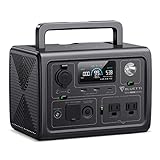
The Bluetti EB3A delivers 600W of continuous AC output with 1,200W surge capacity, making it more powerful than most units in its size class. With two AC outlets, it can run small appliances like mini-fridges, CPAP machines, and even some kitchen gadgets. The 100W USB-C PD port ensures compatibility with laptops, while the wireless charging pad adds convenience for smartphones. In total, the EB3A offers nine outputs, making it ideal for users needing multiple devices powered simultaneously.
The Jackery Explorer 300 features a 300W AC inverter with 500W surge capacity, which is more modest but still practical for light-duty devices. It includes six output ports: two AC outlets, a 60W USB-C PD port, two USB-A ports, and a 12V carport. While useful, it lacks the high-powered USB-C output and wireless charging found in the EB3A.
Winner: Bluetti EB3A – Its higher wattage, stronger surge capacity, and broader port selection make it far more versatile for a variety of devices.
Charging Speeds and Solar Integration
One of the EB3A’s biggest strengths is its rapid recharging capability. It supports 350W fast AC charging, reaching 80% in about 30 minutes and fully charging in just over an hour. For off-grid use, its 200W solar input allows it to recharge in around 1.5–2 hours under optimal sunlight, making it highly efficient.
The Explorer 300 also performs well for its class. It can recharge in about 2 hours when combining AC input with USB-C PD charging, or around 4.5 hours with AC alone. However, its solar input is limited to 100W, meaning recharging with panels can take 3–4 hours in ideal conditions.
Winner: Bluetti EB3A – Its blazing-fast AC recharge and higher solar input capacity provide unmatched convenience for frequent or off-grid users.

Design, Portability, and Build Quality
The Bluetti EB3A weighs 10.1 lbs (4.6 kg), making it slightly heavier than the Explorer 300. Its design is compact, modern, and includes a foldable handle for transport. While bulkier, it justifies the extra weight with higher output power and more features.
The Jackery Explorer 300 weighs 7.1 lbs (3.2 kg), offering better portability for those who prioritize lightness. Its signature orange-and-black design is rugged, practical, and easy to carry on trips. The reduced weight makes it better suited for users who need a compact backup without heavy lifting.
Winner: Jackery Explorer 300 – It is lighter and easier to carry, though Bluetti offers more performance in exchange for added bulk.
Smart Features and App Integration
The Bluetti EB3A comes with Wi-Fi and Bluetooth app control, allowing users to monitor battery performance, manage charging modes, and perform firmware updates remotely. This smart functionality adds a modern layer of convenience, particularly for tech-savvy users.
The Jackery Explorer 300 does not offer any app control. Its simple LCD display shows charging status, remaining battery percentage, and output details. While easy to use, it lacks the advanced features found in Bluetti’s app ecosystem.
Winner: Bluetti EB3A – Its smart app integration gives it a significant edge in usability and control.
Quick Rundown Of Bluetti EB3A

Quick Rundown Of Jackery Explorer 300
Conclusion
Both the Bluetti EB3A and the Jackery Explorer 300 are capable compact power stations, but they serve slightly different needs. The Explorer 300 appeals to those who value portability and simplicity, offering a lightweight design with just enough power for small electronics during short trips.
The EB3A, however, stands out as the more advanced and powerful option. With its faster charging, longer-lasting LiFePO₄ battery, higher output capacity, broader port selection, and smart app controls, it is better suited for users who want a future-proof and versatile solution.
Overall Winner: Bluetti EB3A – It provides superior performance, durability, and features, making it the best choice for anyone seeking reliability and versatility in a compact portable power station.