
As the demand for portable power stations grows, Anker has positioned itself as a market leader by producing heavy-duty, reliable, and smart solutions for off-grid living, RV users, and home backup. Among its most powerful models, the Anker Solix F2600 vs Anker Solix F3800 stand out as serious contenders for those who want dependable high-capacity power. Both use LiFePO₄ battery chemistry, both support fast charging and solar input, and both offer smart app control—but their scale, design, and intended use cases differ greatly.
In this detailed guide, we compare the Anker Solix F2600 vs Solix F3800 across capacity, expandability, output power, charging speed, solar integration, design, and smart features to determine which one is the best fit for your power needs.

Contents
Differences Between Anker Solix F2600 vs Solix F3800
Below is a summary of the specifications:

Battery Capacity and Expandability
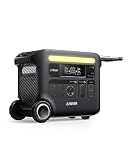
The F2600 starts with a 2,560Wh LiFePO₄ battery, offering excellent performance for multi-day camping trips, RV power, and backup for critical home devices. It supports expansion with a 760Wh extra pack, bringing the total to around 3,320Wh. While respectable, this level of capacity is best for short-term use or specific applications like RV setups or job sites.
The F3800, in contrast, comes with a 3,840Wh base battery, already providing significantly more runtime than the F2600. More importantly, it is expandable up to 26.9kWh when paired with additional battery packs. This makes it a whole-home backup solution, capable of running refrigerators, HVAC systems, and essential circuits for days at a time.
Winner: Anker Solix F3800
With its massive base capacity and unmatched expandability, the F3800 is the best choice for users needing serious long-term power autonomy.

Power Output and Device Compatibility
The F2600 delivers 2,400W continuous output with a 2,800W surge, enough to power microwaves, coffee machines, laptops, CPAP machines, TVs, routers, and multiple small appliances simultaneously. Its port selection includes 4 AC outlets, 1 RV port, 3 USB-C ports (100W), 2 USB-A, and 2 carports, giving it excellent versatility for both indoor and outdoor setups.
The F3800 is in another league. It provides 6,000W continuous output with 9,000W surge capacity, supporting both 120V and 240V dual-voltage output. This means it can handle large appliances, HVAC systems, induction cooktops, power tools, EVs, and even whole-home circuits when connected through a transfer switch. Its ports include 6 AC outlets, split-phase capability, NEMA 14-50 EV port, 3 USB-C (100W), 2 USB-A, and 2 carports.
Winner: Anker Solix F3800
With triple the output power, dual-voltage compatibility, and EV support, the F3800 is far superior for users with large appliances or home integration needs.
Charging Speeds and Solar Integration
The F2600 features HyperFlash AC charging, reaching 80% in just 1.4 hours with up to 1,440W input. Its 1,000W MPPT solar input allows efficient off-grid recharging, making it practical for RV owners or solar panel users.
The F3800 outperforms with 1,800W AC charging, achieving a full recharge in under 2 hours, despite its larger battery. Its 2,400W solar input capacity ensures it can sustain long-term off-grid use with fewer panels or limited sunlight.
Winner: Anker Solix F3800
The faster AC recharging and double solar input capacity make the F3800 the superior choice for renewable energy setups and continuous usage.

Design, Portability, and Build Quality
At 69.7 lbs, the F2600 is heavy but still relatively portable, featuring rugged wheels and a pull handle for easier mobility. Its design makes it suitable for RV living, outdoor work sites, and semi-permanent setups where portability is required but performance cannot be compromised.
The F3800, at 132 lbs, is much heavier and intended for stationary or semi-permanent setups. It also includes industrial-grade wheels and reinforced handles, but moving it around frequently is less practical. Its build is robust, with reinforced casing, thermal management, and shock resistance, but mobility is not its strength.
Winner: Anker Solix F2600
For portability and mobile applications, the F2600 is the better option, while the F3800 focuses on capacity and home-scale power delivery.
Smart Features and App Integration
Both the F2600 and F3800 feature Wi-Fi and Bluetooth connectivity, allowing control via the Anker app. Through the app, users can monitor real-time energy usage, input/output levels, charging preferences, and system health. Both models include UPS functionality with <20ms switchover, protecting sensitive electronics during outages.
The F3800 extends smart integration further, offering home panel connectivity, split-phase support, and EV charging capabilities. It is not just a portable power station—it’s a full smart home energy management system.
Winner: Anker Solix F3800
With advanced integration features, dual-voltage control, and EV compatibility, the F3800 takes the lead in smart power management.
Quick Rundown Of Anker Solix F2600

Quick Rundown Of Anker Solix F3800
Conclusion
The Anker Solix F2600 is an excellent solution for those who need high-capacity portable power with reasonable portability. It is well-suited for RVs, camping, outdoor work, and small-scale home backup, offering reliable performance in a manageable package.
The Anker Solix F3800, however, is a true powerhouse. With its larger base capacity, massive expandability, 6,000W/9,000W output, EV charging, and smart home integration, it is designed to replace traditional backup generators and provide long-term whole-home resilience.
Overall Winner: Anker Solix F3800
Its unmatched capacity, output, scalability, and smart integration make the F3800 the best choice for users who demand serious, future-proof energy independence.