
Portable power stations have become an essential part of modern living, whether for home backup, outdoor adventures, or professional use in the field. Two strong competitors in this segment are the Anker Solix F2000 vs EcoFlow Delta 2.
Both offer LiFePO₄ battery technology, rapid charging, and app integration, but they differ significantly in size, performance, and expandability. In this comprehensive guide, we compare the Anker Solix F2000 vs EcoFlow Delta 2 across all critical categories to determine which delivers the best overall value.

Contents
Differences Between Anker Solix F2000 vs EcoFlow Delta 2
Below is a summary of the specifications:

Battery Capacity and Expandability
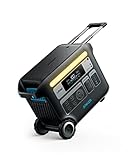
The Anker Solix F2000 offers an impressive 2048Wh LiFePO₄ battery, making it one of the largest in its class. With a cycle life of 3000+ charges to 80%, it guarantees durability for long-term use. Additionally, the F2000 can be paired with an extra expansion battery, increasing its capacity to 4096Wh, making it an excellent option for extended blackouts or off-grid living.
In comparison, the EcoFlow Delta 2 has a 1024Wh LiFePO₄ battery, also rated for 3000+ cycles. While its base capacity is half of the F2000, it supports expandability up to 3040Wh when connected with the Delta 2 Max battery. This makes the Delta 2 more scalable than its base design suggests, although it still falls short of the maximum expansion offered by Anker.
Winner: Anker Solix F2000 – With double the base capacity and greater maximum expansion, it delivers superior storage capabilities.

Power Output and Device Compatibility
The Anker Solix F2000 features a 2400W continuous AC output with a 3600W surge capacity. This allows it to handle large household appliances such as refrigerators, washing machines, air conditioners, and power tools. Its port selection includes 4 AC outlets, 3 USB-C ports (100W each), 2 USB-A ports, dual car outlets, and even a dedicated RV port, giving it unmatched versatility for both residential and professional use.
The EcoFlow Delta 2, while more compact, delivers 1800W continuous power with a 2700W surge limit. It can run 90% of household devices but struggles with high-demand appliances that exceed its rated capacity. On the other hand, its 15 output ports, including 6 AC outlets, USB-C, USB-A, and DC5521 outputs, provide exceptional flexibility for simultaneously powering multiple smaller devices.
Winner: Anker Solix F2000 – Its higher rated and surge output makes it the more capable choice for power-hungry devices and whole-home backup.
Charging Speeds and Solar Integration
The Anker Solix F2000 supports fast AC charging, reaching 80% in about 1.4 hours. While slightly slower than the Delta 2, it compensates with a massive 1000W solar input capacity, which allows it to recharge completely using solar panels in around 2.5 hours under optimal conditions. This makes it an excellent choice for sustainable energy setups and off-grid living.
The EcoFlow Delta 2 is one of the fastest-charging power stations in its category, capable of reaching 80% charge in just 50 minutes and fully charged in about 80 minutes. Its 500W solar input capacity is half that of the F2000, but it still allows for a full recharge within 3–4 hours under good sunlight conditions.
Winner: EcoFlow Delta 2 – With faster AC charging, it provides convenience for users needing quick turnaround. However, Anker wins in solar flexibility with double the input capacity.

Design, Portability, and Build Quality
The Anker Solix F2000 is built as a heavy-duty power station, weighing 67.3 lbs (30.5 kg). Its design includes rugged wheels and an extendable handle, making it easier to transport despite its bulk. The reinforced casing ensures durability for both indoor and outdoor use, and its build quality emphasizes reliability under heavy workloads.
The EcoFlow Delta 2, at just 27 lbs (12 kg), is far more portable. Its compact size makes it easy to carry, store, and transport, making it a great option for camping, road trips, and quick backup needs. While not as rugged as the F2000, it is designed with premium materials and has a solid, user-friendly build.
Winner: EcoFlow Delta 2 – With significantly lower weight and compact size, it is the better choice for mobility.
Smart Features and App Integration
The Anker Solix F2000 integrates with the Anker App via Wi-Fi and Bluetooth, providing detailed insights into battery status, input/output levels, charging speed, and power usage history. It also offers firmware updates to improve long-term performance.
The EcoFlow Delta 2 connects to the EcoFlow App, offering more advanced options such as adjustable charging speeds, customizable charging schedules, and integration with other EcoFlow devices for a complete ecosystem. Its user-friendly interface makes it one of the most polished apps in the industry.
Winner: EcoFlow Delta 2 – Its app ecosystem and customizable settings are more advanced, giving it an edge in smart energy management.
Quick Rundown Of Anker Solix F2000

Quick Rundown Of EcoFlow Delta 2

Conclusion
Both the Anker Solix F2000 and the EcoFlow Delta 2 deliver outstanding performance, but they are tailored to different users.
The Anker Solix F2000 is the powerhouse of the two, designed for serious energy needs, long-term outages, and heavy appliance compatibility. Its massive capacity, high solar input, and rugged build make it ideal for homeowners and professionals who need uncompromising power and reliability.
The EcoFlow Delta 2, however, is the more portable and versatile option, excelling in fast AC charging, advanced app features, and expandable scalability. It is perfect for campers, road trippers, and everyday users who want a lighter, smarter, and highly efficient solution.
Overall Winner: Anker Solix F2000 – With greater capacity, stronger output, and unmatched solar capability, it takes the crown as the more powerful and future-ready portable power station. The EcoFlow Delta 2 remains an excellent choice for those who value portability and intelligent energy management, but the F2000 dominates for users who prioritize raw power and scalability.