
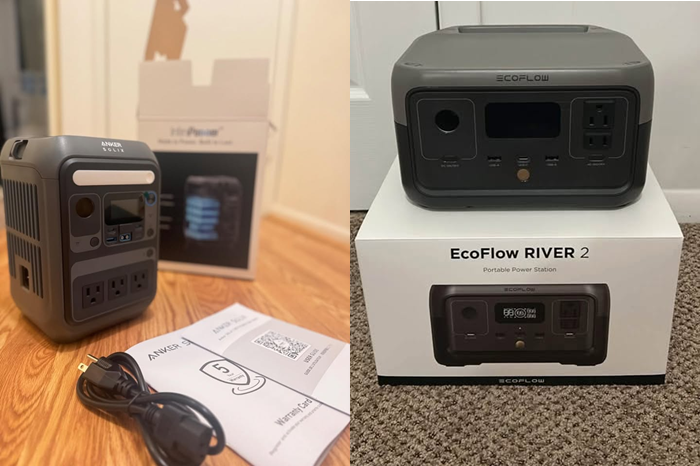
When evaluating portable power stations, the Anker Solix C300 vs EcoFlow River 2 stand out in the compact and entry-level category. Both are designed for portability, quick charging, and everyday versatility, but their differences become clear when examining specifications, performance, and long-term usability.
This guide provides a thorough comparison of both models to help determine which one is the superior choice for various applications.
Contents
Differences Between Anker Solix C300 vs EcoFlow River 2
Below is a summary of the specifications:


Battery Capacity and Lifespan
The Anker Solix C300 comes with a 288Wh LiFePO₄ battery, giving it a slight edge over the EcoFlow River 2’s 256Wh capacity. This additional capacity translates into longer runtimes for essential electronics such as laptops, drones, tablets, cameras, or even small appliances like mini-fridges. With over 3000 charge cycles to 80%, the Solix C300 offers durability that supports nearly a decade of daily use.
The EcoFlow River 2, although smaller at 256Wh, maintains a strong reputation for long-term reliability. Its LiFePO₄ chemistry provides 3000+ cycles, which means it can be recharged daily for years without major degradation. While it carries slightly less energy storage than the C300, it is still sufficient for mobile charging and short-duration emergency use.
Winner: Anker Solix C300 – With its larger 288Wh battery, it offers more usable runtime while maintaining excellent durability.

Power Output and Device Compatibility
The Anker Solix C300 delivers 300W continuous output and 600W surge capability, allowing it to handle devices like CPAP machines, routers, LED lights, fans, and small projectors. It comes with 2 AC outlets, a USB-C port (60W), 2 USB-A ports, and a 12V car outlet, covering common charging needs for personal electronics and smaller appliances.
The EcoFlow River 2 also supports 300W continuous output with 600W surge power. Where it stands apart is its X-Boost technology, which can intelligently run devices requiring up to 600W continuous draw by reducing voltage without overloading the unit. This makes it slightly more versatile than the Solix C300 when handling higher-demand appliances. Its ports include 2 AC outlets, 1 USB-C (60W), 2 USB-A ports, and a 12V car outlet, ensuring compatibility with most portable devices.
Winner: EcoFlow River 2 – X-Boost technology gives it an advantage in running more demanding appliances.
Charging Speeds and Solar Integration
The Anker Solix C300 offers rapid recharging with its advanced AC charging system, reaching 80% in about 50 minutes and a full recharge in approximately one hour. For solar charging, it supports a maximum input of 100W, allowing eco-friendly recharging in about 3–4 hours under ideal conditions.
The EcoFlow River 2 excels in charging speed with X-Stream technology, achieving a full recharge from 0–100% in just one hour. Its 110W solar input capacity allows it to recharge in around 3 hours with compatible solar panels, making it slightly more efficient in renewable energy scenarios.
Winner: EcoFlow River 2 – Faster and more efficient, especially with solar integration.

Design, Portability, and Build Quality
The Anker Solix C300 weighs 8.8 lbs (4 kg), offering a rugged build and reinforced casing for durability. It is compact and easy to transport, but slightly heavier than the River 2. Its design focuses on toughness and reliability, making it well-suited for outdoor use where resilience is a priority.
The EcoFlow River 2 is lighter at 7.7 lbs (3.5 kg), making it more travel-friendly for camping, road trips, and everyday portability. While not as rugged as the Solix C300, its compact form and ergonomic handle enhance convenience for frequent transport.
Winner: EcoFlow River 2 – Its lighter build makes it easier to carry without sacrificing performance.
Smart Features and App Integration
The Anker Solix C300 connects through the Anker App, which provides essential monitoring tools such as battery level, input/output power, and firmware updates. It also features an ultra-fast 10 ms UPS switchover, ensuring seamless power delivery for sensitive devices like computers and medical equipment.
The EcoFlow River 2 integrates with the EcoFlow App, offering advanced customization. Users can adjust charging speeds, schedule recharges, and monitor detailed usage statistics. Its EPS function provides backup power with a switchover time of less than 30 ms, reliable for most household electronics but slightly slower than Anker’s UPS.
Winner: Anker Solix C300 – With its faster UPS switchover, it is better suited for mission-critical devices.
Quick Rundown Of Anker Solix C300

Quick Rundown Of EcoFlow River 2
Conclusion
The Anker Solix C300 and EcoFlow River 2 are two highly capable compact power stations, but they serve slightly different priorities.
The Anker Solix C300 is the stronger choice for users who value higher capacity, rugged durability, and ultra-fast UPS performance. Its larger 288Wh battery and 10 ms switchover make it reliable for professional and sensitive applications.
The EcoFlow River 2, however, excels in faster charging, lighter portability, and advanced smart features. With its X-Boost capability and stronger solar integration, it is the more versatile option for outdoor enthusiasts and travelers who prioritize speed and convenience.
Overall Winner: EcoFlow River 2 – With its quick recharging, enhanced portability, and broader device compatibility, it delivers superior flexibility in everyday use. The Anker Solix C300 remains a strong contender for those who need rugged performance and uninterrupted backup power, but the River 2 edges ahead as the most complete portable solution in this comparison.