
Choosing the right portable power station is essential whether you are planning an outdoor adventure, preparing for emergencies, or simply looking for a reliable power backup. Two of the most talked-about mid-range models are the Anker 535 vs EcoFlow River 2 Max. While both use advanced LiFePO₄ battery technology and provide clean, renewable energy options, they differ significantly in terms of capacity, charging speed, portability, and features. In this comprehensive guide, we analyze each aspect of these power stations to help you decide which is the better fit for your needs.

Contents
Differences Between Anker 535 vs EcoFlow River 2 Max
Below is a summary of the specifications:


Battery Capacity and Expandability
Both the Anker 535 PowerHouse and the EcoFlow River 2 Max are equipped with a 512Wh LiFePO₄ battery, offering a balance between portability and usable energy. This capacity is suitable for powering small appliances, charging multiple devices simultaneously, and providing backup during short outages.
Neither model supports battery expansion, meaning the available 512Wh is the maximum capacity. However, both boast over 3000 charge cycles before dropping to 80% capacity, ensuring exceptional longevity compared to traditional lithium-ion batteries.
Winner: Tie – Both deliver identical capacity and long-lasting LiFePO₄ chemistry.

Power Output and Device Compatibility
The Anker 535 delivers 500W continuous AC output with a 750W surge, making it capable of running laptops, projectors, fans, and even mini-fridges. With 4 AC outlets, 3 USB-A ports, 1 USB-C port, a car outlet, and DC output, it offers a versatile range of connections for users who need to power multiple devices.
The EcoFlow River 2 Max also provides 500W continuous AC output, but it stands out with X-Boost technology, which allows it to handle appliances up to 1000W. This makes it more flexible for powering higher-demand devices. It features 4 AC outlets, 3 USB-A ports, 1 USB-C PD (100W) port, and a car outlet, giving it similar versatility but with the advantage of USB-C fast charging for laptops and other power-hungry electronics.
Winner: EcoFlow River 2 Max – Thanks to X-Boost and 100W USB-C charging.
Charging Speeds and Solar Integration
One of the most critical differences lies in charging technology. The EcoFlow River 2 Max is equipped with X-Stream fast charging, allowing it to recharge from 0–100% in just 60 minutes via AC. This is one of the fastest recharge times in the industry, making it incredibly convenient for users who need quick turnarounds.
The Anker 535, while still reasonably fast, requires around 2.5 hours for a full AC recharge. For solar input, the EcoFlow River 2 Max accepts up to 220W solar, whereas the Anker 535 is limited to 200W. Both can recharge in 3–4 hours under optimal sunlight, though EcoFlow has the edge in maximum solar efficiency.
Winner: EcoFlow River 2 Max – Its lightning-fast AC charging and higher solar input capacity give it a clear advantage.
Design, Portability, and Build Quality
The Anker 535 weighs 16.5 lbs (7.5 kg), making it heavier and bulkier compared to the EcoFlow River 2 Max’s 13.4 lbs (6.1 kg). Anker’s design emphasizes ruggedness, with reinforced casing, a solid handle, and thermal ventilation to ensure stable performance over long periods. It is built like a dependable workhorse.
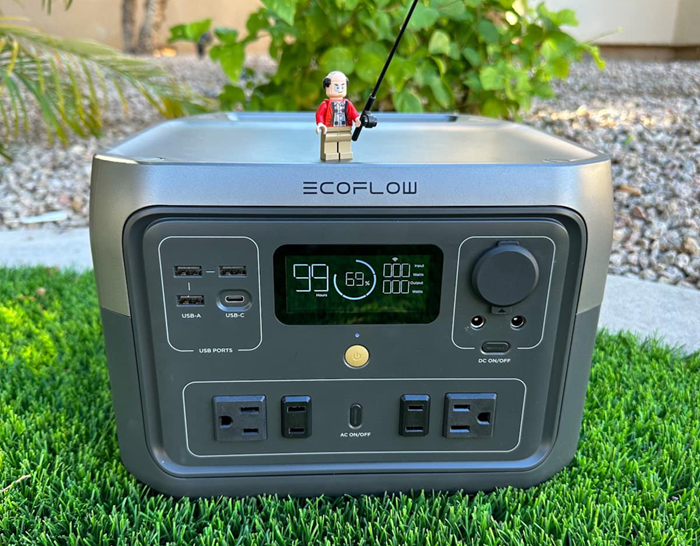
The EcoFlow River 2 Max is lighter and easier to carry, making it a better choice for travelers, campers, or anyone who values portability. It also features a modern, minimalist design with intuitive controls and a highly visible LCD screen for monitoring usage.
Winner: EcoFlow River 2 Max – More compact, lighter, and travel-friendly.
Smart Features and App Integration
The EcoFlow River 2 Max integrates seamlessly with the EcoFlow mobile app, enabling remote monitoring, charging speed adjustments, and firmware updates via Wi-Fi or Bluetooth. This intelligent connectivity transforms the user experience, allowing greater control and optimization of energy usage.
The Anker 535, while reliable, lacks app connectivity. Users must rely solely on its onboard display for information, which limits flexibility compared to EcoFlow’s ecosystem.
Winner: EcoFlow River 2 Max – Superior smart features and app control.
Quick Rundown Of Anker 535

Quick Rundown Of EcoFlow River 2

Conclusion
The competition between the Anker 535 PowerHouse and the EcoFlow River 2 Max highlights two different approaches to portable power. The Anker 535 excels with rugged durability, a strong port selection, and reliable mid-range power delivery, making it a dependable choice for home backup and outdoor enthusiasts who value build quality.
The EcoFlow River 2 Max, however, leads with its rapid charging speeds, superior portability, advanced app integration, and X-Boost technology that extends its versatility to higher-wattage appliances. Its modern design and intelligent ecosystem make it more adaptable to the demands of today’s users.
Overall Winner: EcoFlow River 2 Max – With lightning-fast charging, better portability, advanced app features, and expanded output flexibility, it emerges as the more complete and future-ready power station.