
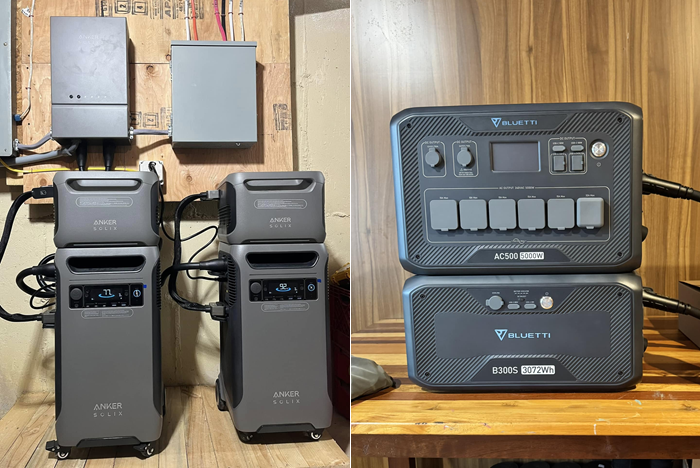
The Anker SOLIX F3800 vs Bluetti AC500 represent the pinnacle of modern modular solar generators, designed for large-scale home backup and off-grid independence. Both models boast high-capacity LiFePO4 batteries, expandable designs, powerful AC output ratings, and advanced solar integration.
In this detailed comparison, we analyze every critical specification to determine which system stands out as the ultimate solution for serious energy needs.
Contents
Differences Between Anker SOLIX F3800 vs Bluetti AC500
Below is a summary of the specifications:


Battery Capacity and Expandability
The Anker SOLIX F3800 is equipped with a massive 3,840Wh LiFePO4 battery as standard, giving it a substantial advantage out of the box. More impressively, it supports expansion with up to six additional batteries, bringing the total system capacity to an astounding 26,880Wh. This makes it suitable for powering entire households during outages or supporting extended off-grid living without compromise.
The Bluetti AC500, on the other hand, is a modular-only power station, meaning it does not include a built-in battery. Instead, it must be paired with at least one B300S battery pack (3,072Wh) to function. Its modular design supports up to six B300S units, reaching a maximum of 18,432Wh. While impressive, it falls short of the Anker in overall expansion potential.
Winner: Anker SOLIX F3800 – Its higher base capacity and industry-leading expansion to nearly 27kWh make it unmatched for large-scale energy storage.

Power Output and Device Compatibility
The Anker SOLIX F3800 delivers 6,000W of rated AC output with an enormous 12,000W surge capacity, enabling it to handle virtually any appliance, including central air conditioning systems, power-hungry tools, and multiple large devices simultaneously. Its 14 output ports include 6 AC outlets, 2 USB-C 100W ports, 2 USB-A ports, a 30A RV outlet, a car DC outlet, and dedicated DC outputs, ensuring compatibility across household, outdoor, and professional setups.
The Bluetti AC500 provides 5,000W of rated AC power with a 10,000W surge, also capable of running nearly any high-powered device. It offers versatile output options, but since it relies on modular expansion batteries, the exact port configuration varies. Notably, it also includes an RV outlet, AC outputs, multiple USB ports, and DC options, making it highly versatile.
Winner: Anker SOLIX F3800 – With greater continuous AC power, higher surge capacity, and a fully integrated wide port selection, it edges out the Bluetti AC500 for demanding applications.
Charging Speeds and Solar Integration
The Anker SOLIX F3800 features a highly efficient dual AC charging system, capable of accepting up to 3,000W per input, recharging the 3.8kWh battery in about 1.5 hours. For solar, it supports up to 2,400W of input, making it an excellent option for renewable energy setups.
The Bluetti AC500 shines in the solar department, offering up to 3,000W solar input with advanced MPPT controllers. When combined with dual AC inputs, it can achieve up to 8,000W total input (AC + solar), enabling ultra-fast charging even with larger modular setups.
Winner: Bluetti AC500 – Its superior solar input capacity and combined charging options make it the more efficient choice for solar-heavy users.

Design, Portability, and Build Quality
The Anker SOLIX F3800 is a heavy-duty power station, weighing 132 lbs due to its built-in high-capacity battery. To improve usability, it includes integrated wheels and a telescopic handle, allowing users to transport it more easily despite the weight. Its rugged design and reinforced casing ensure durability for long-term use.
The Bluetti AC500 weighs only 66.2 lbs for the main unit, but since it requires at least one expansion battery, its real-world portability depends on how many battery packs are connected. Each B300S weighs about 83 lbs, which can add up quickly in multi-battery configurations. While modularity offers flexibility, it also complicates portability.
Winner: Anker SOLIX F3800 – Though heavier, its integrated wheels and all-in-one design make it easier to move than Bluetti’s modular system.
Smart Features and App Integration
Both the Anker SOLIX F3800 and the Bluetti AC500 come with Wi-Fi and Bluetooth connectivity, allowing remote monitoring, output management, and firmware updates through dedicated mobile apps.
The Anker app emphasizes simplicity, giving users an intuitive interface to track power consumption, charging status, and battery health. The Bluetti app provides more granular control, offering detailed insights into solar input, AC load balancing, and multi-battery management.
Winner: Tie – Both excel in app integration, with Anker offering user-friendliness and Bluetti delivering advanced customization.
Quick Rundown Of Anker SOLIX F3800

Quick Rundown Of Bluetti AC500
Conclusion
The Anker SOLIX F3800 and the Bluetti AC500 are designed for users with serious energy demands, whether for home backup, RV living, or full off-grid systems. Both deliver exceptional reliability, cutting-edge technology, and long-lasting LiFePO4 performance.
The Anker SOLIX F3800 stands out with its larger built-in capacity, higher AC output, and superior expandability up to 26.8kWh. It is the better choice for users seeking an all-in-one powerhouse that can handle everything from heavy appliances to whole-house backup without additional modules.
The Bluetti AC500, however, is the champion for solar integration and modular flexibility. Its ability to absorb up to 3,000W of solar input makes it ideal for those prioritizing renewable energy, and its modular design lets users scale capacity based on budget and needs.
Overall Winner: Anker SOLIX F3800 – With greater output power, larger expansion potential, and a built-in large-capacity battery, it offers the most robust and versatile solution for demanding users who want maximum performance in a single integrated system.