
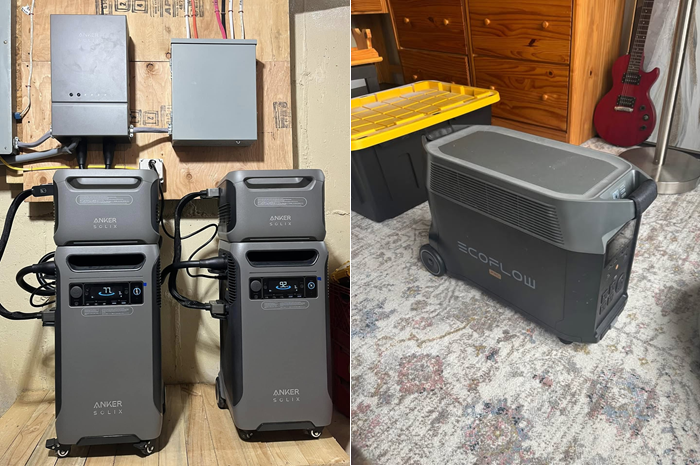
The rise of high-capacity portable power stations has transformed how we think about backup power, off-grid living, and renewable energy integration. Two of the most advanced solutions currently on the market are the Anker Solix F3800 and the EcoFlow Delta Pro. Both represent the pinnacle of modern battery technology, featuring LiFePO₄ chemistry, multi-kilowatt outputs, solar integration, and smart connectivity. Yet, despite their similarities, these two units target slightly different needs in terms of capacity, expandability, power output, and ecosystem integration.
In this comprehensive guide, we conduct a head-to-head analysis of the Anker Solix F3800 vs EcoFlow Delta Pro, breaking down their strengths and weaknesses across every category.
Contents
Differences Between Anker Solix F3800 vs EcoFlow Delta Pro
Below is a summary of the specifications:


Battery Capacity and Expandability
The Anker Solix F3800 comes with a 3840Wh LiFePO₄ battery, positioning it slightly above the EcoFlow Delta Pro’s 3600Wh base capacity. With a cycle life exceeding 3000 cycles to 80%, the F3800 ensures long-term durability. Most importantly, it is expandable up to 26,880Wh by pairing with multiple expansion batteries, enabling it to provide sustained backup power for entire homes or off-grid systems.
The EcoFlow Delta Pro features a 3600Wh LiFePO₄ battery with 3500+ cycles, giving it a marginal advantage in overall longevity. Its expandability is equally impressive, scaling up to 25,000Wh with additional batteries and EcoFlow’s Smart Home Panel. This makes it a full-fledged home backup solution, integrated into a smart energy ecosystem.
Winner: Anker Solix F3800 – With a slightly higher base capacity and larger maximum expandability, it edges out the Delta Pro in this category.

Power Output and Device Compatibility
The Anker Solix F3800 delivers an extraordinary 6000W continuous output with 9000W surge capability, enabling it to run virtually any household appliance, from HVAC systems to ovens and heavy-duty workshop tools. It also supports split-phase 240V output, making it highly suitable for home backup applications. Its ports include 6 AC outlets, dual USB-C (100W), dual USB-A, a 12V car port, and an RV outlet, covering a wide range of needs.
The EcoFlow Delta Pro provides 3600W continuous output and a 7200W surge rating. While slightly lower in standalone power compared to the F3800, it can be paired with another Delta Pro to achieve 7200W output with 240V split-phase support. Its versatile port selection includes AC outlets, high-power USB-C ports, USB-A, a 12V outlet, an Anderson port, and an EV charging port, making it one of the most flexible systems available.
Winner: Anker Solix F3800 – With higher standalone output and integrated split-phase capability, it surpasses the Delta Pro in raw power.
Charging Speeds and Solar Integration
The Anker Solix F3800 supports up to 2400W solar input, allowing for rapid renewable charging and making it ideal for large-scale off-grid setups. It can also recharge via AC to 80% in about 1.5 hours, providing strong turnaround performance. This makes it a strong choice for users relying heavily on solar power as a primary source.
The EcoFlow Delta Pro accepts up to 1600W of solar input, which is substantial but falls behind the F3800. However, its AC charging is highly versatile, supporting standard wall outlets, EV charging stations (240V fast charging), and even wind turbines with adapters. Its X-Stream AC technology allows for 0–80% charging in 1.8 hours, ensuring reliable recharging in diverse scenarios.
Winner: Anker Solix F3800 – With higher solar capacity, it is more suited to solar-first users, though EcoFlow wins in charging versatility.

Design, Portability, and Build Quality
The Anker Solix F3800 is built for heavy-duty use, weighing 132 lbs (60 kg). Despite its heft, it includes rugged wheels and a telescopic handle, making it movable like a large suitcase. Its reinforced casing and robust build are designed to handle demanding environments, ensuring reliability during long-term use.
The EcoFlow Delta Pro is lighter at 99 lbs (45 kg), giving it an edge in portability. It also includes wheels and a handle for easier transportation. Its compact design relative to its capacity makes it more convenient for users who plan to move their power station frequently between home, RV, and outdoor applications.
Winner: EcoFlow Delta Pro – With a lighter weight and easier portability, it is more practical for users who value mobility.
Smart Features and App Integration
The Anker Solix F3800 connects via the Anker App, enabling real-time monitoring of power usage, input/output, and charging status. It supports firmware updates and remote management, but its ecosystem is relatively limited compared to EcoFlow’s broader offerings.
The EcoFlow Delta Pro integrates seamlessly into the EcoFlow App, offering extensive customization, smart charging schedules, energy monitoring, and compatibility with the EcoFlow Smart Home Panel. This allows users to integrate their Delta Pro into a full-fledged home energy management system, which can include solar panels, batteries, and generators in a unified network.
Winner: EcoFlow Delta Pro – Its advanced app ecosystem and smart home integration make it far more versatile for connected energy management.
Quick Rundown Of Anker Solix F3800

Quick Rundown Of EcoFlow Delta Pro
Conclusion
Both the Anker Solix F3800 and the EcoFlow Delta Pro represent the cutting edge of portable power technology.
The Anker Solix F3800 is the clear leader in raw power output and solar integration. With its 3840Wh base capacity, 6000W output, 9000W surge, and 2400W solar input, it is ideal for users who want maximum standalone performance and heavy reliance on renewable energy.
The EcoFlow Delta Pro, however, excels in smart integration, expandability, and ecosystem compatibility. With home panel integration, EV charging support, and a lighter build, it offers greater versatility for long-term home energy solutions.
Overall Winner: EcoFlow Delta Pro – While the Anker Solix F3800 dominates in raw numbers, the Delta Pro’s ecosystem, smart home integration, and balance of power with portability make it the more complete and future-ready energy solution. The F3800 remains an outstanding choice for users prioritizing standalone power and solar-heavy setups, but the Delta Pro leads for overall versatility.