
When it comes to large-capacity portable power stations, Anker has positioned itself as a leader with its Solix series, offering advanced technology, long-lasting batteries, and versatile applications. Two of its flagship models—the Anker Solix F2000 vs Anker Solix F3800—are designed for different classes of users. The F2000 is compact enough for RVs and off-grid living, while the F3800 is engineered as a whole-home backup solution capable of supporting heavy appliances and even EV charging.
This in-depth guide compares the Anker Solix F2000 vs Solix F3800, breaking down their strengths across battery capacity, power output, expandability, solar integration, portability, and smart control features. By the end, you’ll have a clear understanding of which unit best meets your energy needs.
Contents
Differences Between Anker Solix F2000 vs Solix F3800
Below is a summary of the specifications:

Battery Capacity and Expandability
The Anker Solix F2000 features a 2,048Wh LiFePO₄ battery, providing reliable energy storage for daily needs such as refrigerators, routers, laptops, CPAP machines, and small cooking appliances. It is expandable to 4,096Wh with an extra battery, doubling its runtime, which makes it ideal for extended RV trips and short-term power outages.
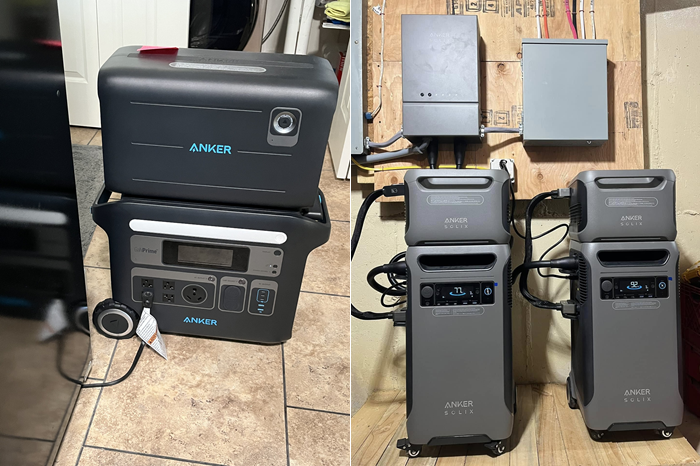
On the other hand, the Anker Solix F3800 offers a massive 3,840Wh base capacity, nearly twice that of the F2000. More impressively, it is expandable up to 26.9kWh with additional modules, transforming it into a whole-home backup power solution capable of supporting critical circuits for days without sunlight or grid power.
Winner: Anker Solix F3800
With higher base storage and unmatched expandability, the F3800 is designed for users who demand maximum energy autonomy.

Power Output and Device Compatibility
The F2000 delivers 2,300–2,400W of continuous AC output with a 3,600W surge capacity, enough to power microwaves, washing machines, air conditioners, and power tools. It comes with 4 AC outlets, a dedicated RV port (TT-30), 3 USB-C ports (100W each), 2 USB-A ports, and 2 carports—providing excellent versatility for both home and RV users.
The F3800 dwarfs this with a staggering 6,000W continuous output and 9,000W surge capacity, while offering 120V and 240V dual voltage compatibility. This allows it to power large HVAC systems, electric ranges, deep freezers, welding equipment, and even EVs. Its ports include 6 AC outlets, split-phase capability, NEMA 14-50 for EVs, 3 USB-C (100W), 2 USB-A, and 2 carports, making it a true powerhouse for industrial-level loads.
Winner: Anker Solix F3800
Its dual-voltage support and enormous output make the F3800 the ultimate choice for powering heavy-duty appliances and entire households.
Charging Speeds and Solar Integration
The F2000 supports HyperFlash AC charging at up to 1,440W, allowing it to reach 80% in about 1.4 hours. It also accepts up to 1,000W of solar input, enabling a full charge in around 2.5–3 hours in strong sunlight.
The F3800 improves on this with 1,800W AC charging, capable of recharging fully in under 2 hours despite its much larger capacity. Its 2,400W solar input is industry-leading, allowing it to sustain long off-grid operations with fewer panels or reduced sunlight.
Winner: Anker Solix F3800
The superior solar input and faster AC recharge make the F3800 the best option for sustainable, renewable energy setups.

Design, Portability, and Build Quality
The F2000, at 67 lbs, is heavy but portable, equipped with rugged wheels and a telescopic handle, making it practical for RV travel and backyard movement. Its compact size relative to its capacity makes it one of the more transportable units in its class.
The F3800, however, weighs a hefty 132 lbs, nearly double that of the F2000. It also features heavy-duty wheels and a reinforced handle, but it is clearly intended for semi-permanent setups in homes, cabins, or RV bases rather than frequent relocation.
Winner: Anker Solix F2000
For portability and mobility, the F2000 is the clear choice, while the F3800 prioritizes capacity over convenience.
Smart Features and App Integration
Both the F2000 and F3800 are equipped with Wi-Fi and Bluetooth connectivity, allowing users to control and monitor via the Anker app. The app provides real-time insights into power usage, input/output wattage, battery status, and charging priorities. It also allows for firmware updates, scheduling, and UPS mode customization.
The F3800 goes further with home panel integration, enabling direct connection to household circuits, and supports split-phase output for running 240V appliances. It also has dedicated support for EV charging, making it more versatile for modern energy demands.
Winner: Anker Solix F3800
Its advanced app control, split-phase compatibility, and EV integration set it apart as the smarter, more adaptable option.
Quick Rundown Of Anker Solix F2000

Quick Rundown Of Anker Solix F3800
Conclusion
The Anker Solix F2000 is an excellent choice for users who need a powerful yet portable energy solution. With its expandable 2,048Wh battery, 2,400W output, and RV-friendly design, it is perfect for campers, RV owners, and short-term home backup.
The Anker Solix F3800, however, is in a league of its own. With its huge 3,840Wh base capacity, 6,000W dual-voltage output, 9,000W surge capability, and scalability up to 26.9kWh, it is built for whole-home backup, EV charging, and long-term off-grid living. It is the definitive choice for those who demand maximum energy independence.
Overall Winner: Anker Solix F3800
With its unmatched capacity, scalability, dual-voltage output, and advanced integration features, the F3800 stands as Anker’s most powerful and future-ready portable power station.